The «Light Pollution» is general term that refers to the electromagnetic waves, usually those of visible range, emitted by the artificial sources, mainly from the illumination of streets and buildings at cities, but also by the headlight of vehicles and industries, Airports, studios, fireworks, wildfires, etc..
Often, the Light Pollution is considered as an unwanted by-product of the Human Civilization. Mainly it refers to the night time.
The Light Pollution is especially severe for the astronomic observations in visible range of light. The special efforts to reduce the Light Pollution in vicinities of observatories are applied.
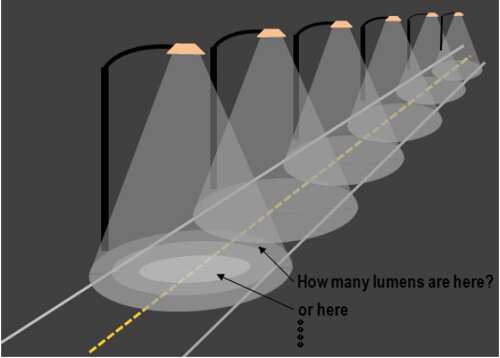
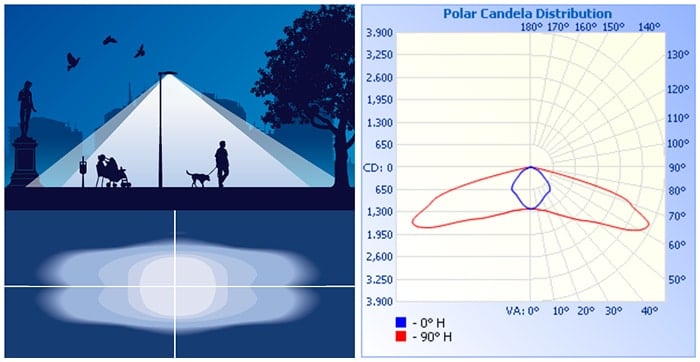
One of ways to reduce the Light pollution refers to the special design of the Light Emitting Diodes providing the streetlight. The two examples are shown in pictures at the top.
At the appropriate limit of the illumination range, drivers can avoid confusing streetlights with car headlights, and light pollution is also reduced.
The main idea is to reduce the intensity of the light that propagates from the source parallel to the ground surface. This light contributes to the Light pollution but does not help the participants of the road traffic; even worse, at a narrow streets with low traffic, such a light can be easy confused with the headlight of a approaching vehicle, and the head lights of an approaching vehicle can be confused with the non-optimized streetlight.
As a side effect, at the optimization of the angular diagram of the emitted light, keeping the same visibility, the consumption of the electric power can be reduced.
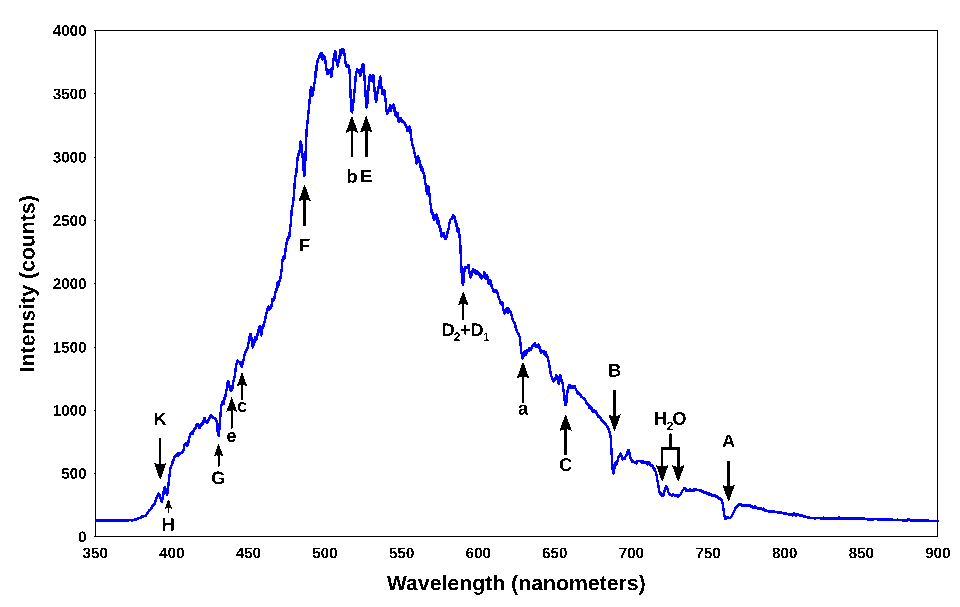
At the clear weather conditions, some part of the scattering in the atmosphere is attributed to transitions in molecules of the air. The corresponding wavelengths are seen in the spectrum by Wikipedia [3] on figure at right. The strongest spectral line "G" is attributed to the scattering by the molecules of the oxygen [4].
One of way of reduction of he light pollution can be related to the exclusion of those frequencies that have highest atmospheric scattering.
As a side effect, the colors of objects in the specially-prepared light becomes closer to the colors observed at the normal day-time natural iullumination.
The average luminous intensity required for safe street lighting can be reduced, for example, by reducing taxes on retroreflectors, on cars and clothing in light, highly visible colors.
As a side effect, the daytime sunlight absorption in cities, especially during the traffic jams, would be slightly reduced.