Ork (Орк) is elementary unit of the Russian cannon fodder sent or prepared for sending to invade another country.
Ork is poorly educated aggressor, occupant performing an aggressive war.
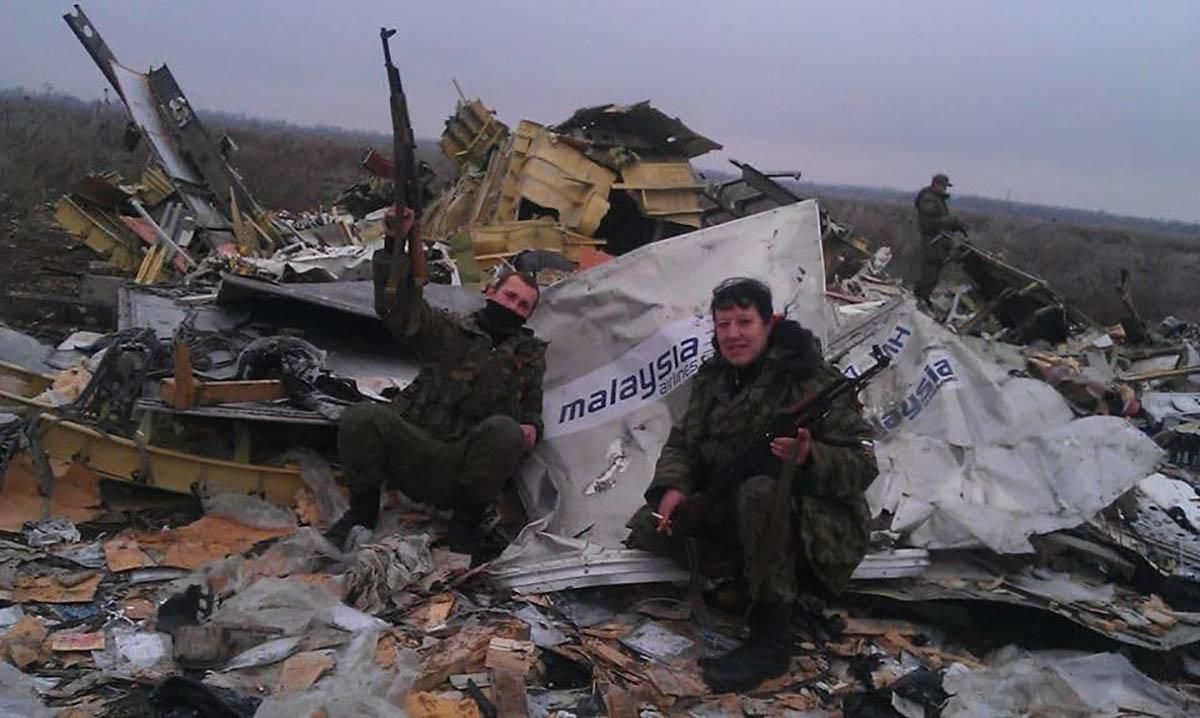
Usually term «Ork» refers to a Russian soldier sent to war against Ukraine, see «Russian invasion into Ukraine».
Usually term «Ork» refers to a Russian soldier sent to war against Ukraine, see «Russian invasion into Ukraine» and «Dvizhuha»; especially since 2022.02.24 (beginning of the full-scale existential total war against Ukraine).
Orks appear as carriers of the primitive moral: «if we robe neighbors, it is good; if they robe us, that is bad». The closest English equivalent is term «Realpolitik» (Borrowed from German); it refers to the short-term criminal planing of relation with other countries with goal to get maximal profit within few years and the hope to avoid the punishment.
Medinski Vladimir Rostislavovich (Мединский Владимир Ростиславович) attributes such a mentality to genetic defects of moscovites (see also «Лишняя хромосома Мединского», in Russian).
Many Orks have committed grave crimes before going to war, and agree to risk their lives and to kill more people in exchange for a promise of official forgiveness from the Russian usurper.
Orks are dangerous and cruel. Human civilization is supposed to defend itself against orks.
The definition of the term and the description are loaded with scientific goals.
The interpretation is not supposed to cause hatred with respect to orks.
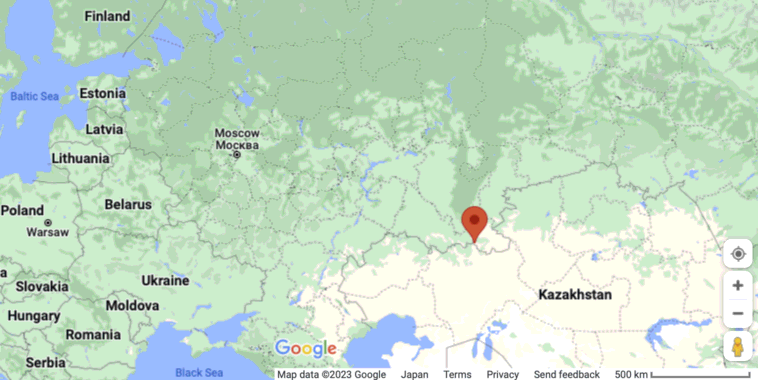
«Ork» is Latin transliteration of Russian term «Орк», apparently created from the name of city Orsk (Орск) at Moscovia. Orsk is located at South of Moscovia, near the border with Kazakhstan.
Orsk is terrorized by the administration of the IriklinskayaPowerPlant (Ириклинская ГЭС).
If operators of IriklinskayaPowerPlant do not collect sufficient bribes from the Orsk people, the operators accumulate water in the reservoire during winter in order to perform the transit spillway («транзитный водосброс») in the spring, causing the catastrophic flood.
Such an incident occurred in April 2024: as there was no reserve capacity to accommodate meltwater, rather than reducing the discharge through the spillway during the April snowmelt, the operators actually increased the volume of water being discharged.
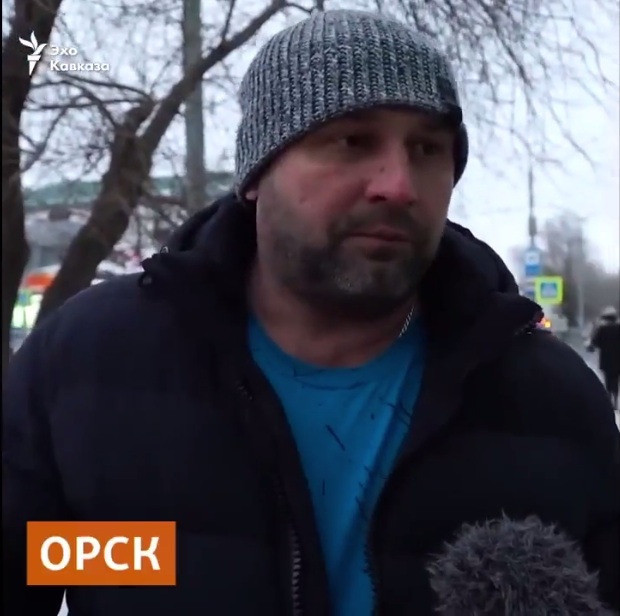
Citizen of Orsk loss their homes, their business and go to robe other counties, in particular, Ukraine (see Dvizhuha ), confirming the ethnology and the sad meaning of term «Ork».
The terrorists' obvious goal was the destruction of civilians' homes in order to force them to participate in the aggressive war.
Such an interpretation shows good agreement with the general concept that the corruption at Moscovia not only got the large scale but become a common, tipical phenomenon that determines the entire life of the Russian offees.
Term «Ork» («Орк») becomes popular since the beginning of the Russian invasion into Ukraine (year 2014). Many Orks are sent to the aggressive war in Ukraine (so called «Dvizhuha») from Orsk or through Orsk.
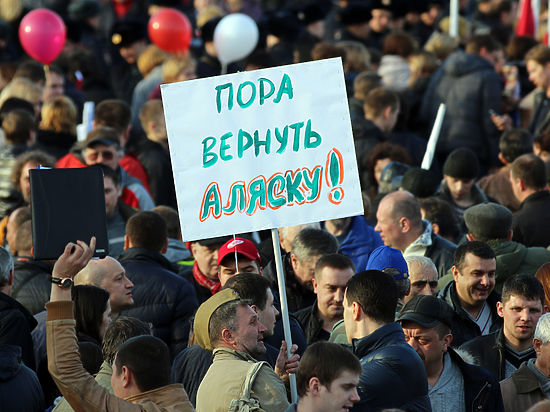
However, term «Ork» may refer to any Russian nazi, aggressor, occupant, even if he (or she) never had been at Orsk (and perhaps does not even know about existence of this city).
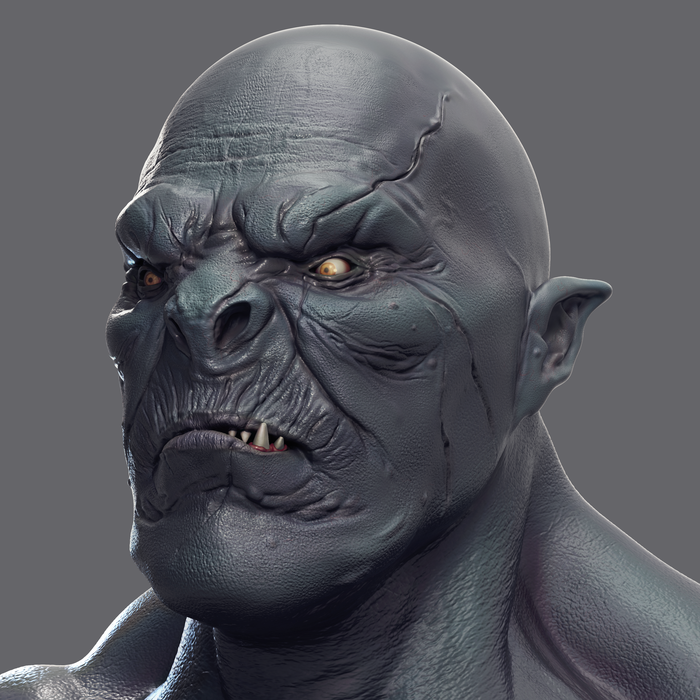
Term «Ork» sounds similar to the generic name «Orc» from the fiction novel by John Ronald Reuel Tolkien and has similar meaning, denoting the dangerous stupid cruel brutal creature used as cannon fodder in an aggressive war.
In Russian, both terms «Ork» and «Orc» correspond to the same word «Орк»; that may cause confusions.
In century 21, the Russian orks play the crucial role in the Putin World war and especially in so-called Dvizhuha against Ukraine and in the expected collapse of RF.
The main goal of Dvizhuha is distraction of the Russian usurer, but also reduction of population of Moscovia to the quantity that is necessary to provide the export of natural resources and to maintain the usurper and his accomplices; in particular, the underground bunkers.
The orks are used as the cannon fodder.
To year 2026, the Russian dvizhuha against Ukraine seems is important mechanism that reduces the population of orks.
Since year 2022, the daily consumption of the Russian cannon fodder grows roughly as a linear function of time; each day, the consumption increases, roughly, for one ors/day.
After 1000 days (roughly, after 3 years; that refers to year 2025) the mean consumption exceeds a 1000 orks/day. The
«Minfin» confirms that at least to year 2026 this general trend still holds.
The linear growth of the daily consumption of the Russian cannon fodder determines the
quadratic growth of the total military loss.
A little bit more adjusted formula estimates the total Russian military loss \(L\) as follows:
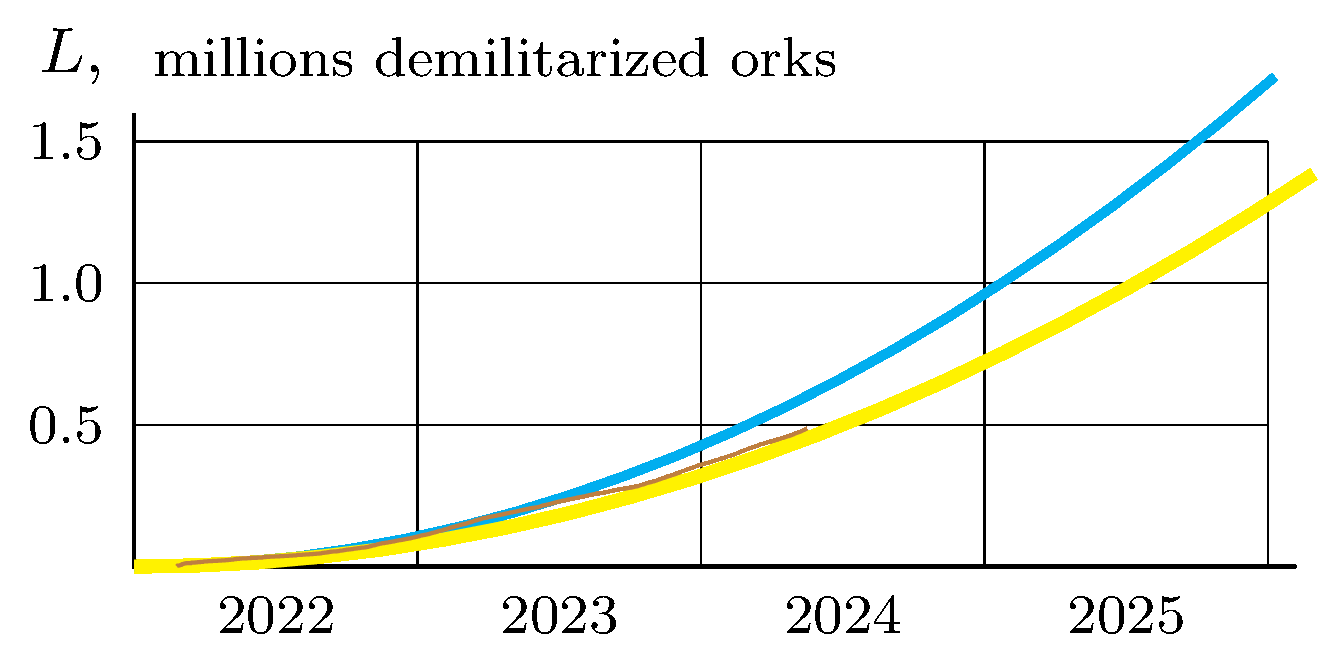
\( L \!=\! 0.8 d^2\)
\( L \!=\! 0.6 d^2\)
Here, \(d\) is time measured in days since the beginning of year 2022.
Coefficient 0.6 in the formula above appears as the adjusting parameter, an empiric constant.
Day 2022.01.01, the loss \(L\) is approximated to zero.
(The actual full-scale Russian invasion begins 2022.02.24)
The dependence above is shown in figure at right with yellow curve.
This curve has special name, «Graphic of Dvizhuha».
In Russian: «График Движухи» or «График спецоперации» or «График Специальной Военной Операции».
The Russian officials confirm, that the Dvishuha follows the graphic.
To year 2026, the Russian official publications do not suggest any other «График Специальной Военной Операции», different from the yellow curve in figure above.
The Graphic of Dvizhuha gives the rough bound, how long the dvizhuha May last.
If the same trend holds for tens of years, then after 40 years of the Dvizhuha,
the Russian Military Loss exceeds the declared population of Russia. That can be considered as
the collapse of RF.
Within this model the Collapse of RF is expected to happen during 21th century.
the Russian dictator or his succeeder happen to be our of the cannon fodder and cannot continue the Putin World war.
The gerankenexperiment, the sci-fi extension of this model is loaded as utopia
«Tartaria».
It describes the almost complete loss of population, industry, ecology, culture and moral at Moscoiva and the attempt to build them up again beginning from almost nothing.
The estimate above can be corrected taking into account that not all population of Moscovia want to become orks and to die as a cannon fodder.
The statistical analysis of the election frauds at Moscovia (Churov Comb («Пила Чурова»), Pamfilova Peak («Пик Памфиловой»))
indicate that of order of a million moscovites vote for the usurper and his party; other ballots for these crimes are added by the corrupted election committees.
This model suggests that the usurper may happen low in orks after few years of the Dvizhuha. Then, the most the supporters of the usurped be spent; the collapse of RF is expected to happen before year 2030.
The similar estimate comes also from the completely independent assumptions.
In the statistical historic model Duration,
the collapse of RF occurs no later than year 2040 at the significance level 83%.
It will be interesting to see, which model of utilization of orks and collapse of RF shows better agreement with the more recent publications.



.jpg)
Definitions of terms are constructed in TORI with scientific goals.
The good definitions are necessary to call things with their proper names.
The interpretation suggested is not an attempt to provoke hatred with respect to Russian soldiers.
Russian writer Tolstoy Lev Nikolayevich (Толстой Лев Николаевич, see picture at right) indicates (see Hadji-Murad#17, Russian original: «Хаджи-Мурат#17») that word «Hatred» is not an adequate term to qualify senses caused by the war crimes committed by the Russian soldiers.
However, the demilitarization and denazification of orks seems to be essential for ability fo develop any kind of science, as well as for preserving of the Human civilization.
The description above should not be interpreted as an attempt to affect the historic events.
It is not an attempt to prolong agony of the putin's RR.
It is not an attempt boost the collapse of RF.
However, Editor still holds his rights (and even duty)
to call things with their proper names,
to propose definitions for terms that cause confusions,
to construct the historic models and
to compare their predictions to a posteriory observations.