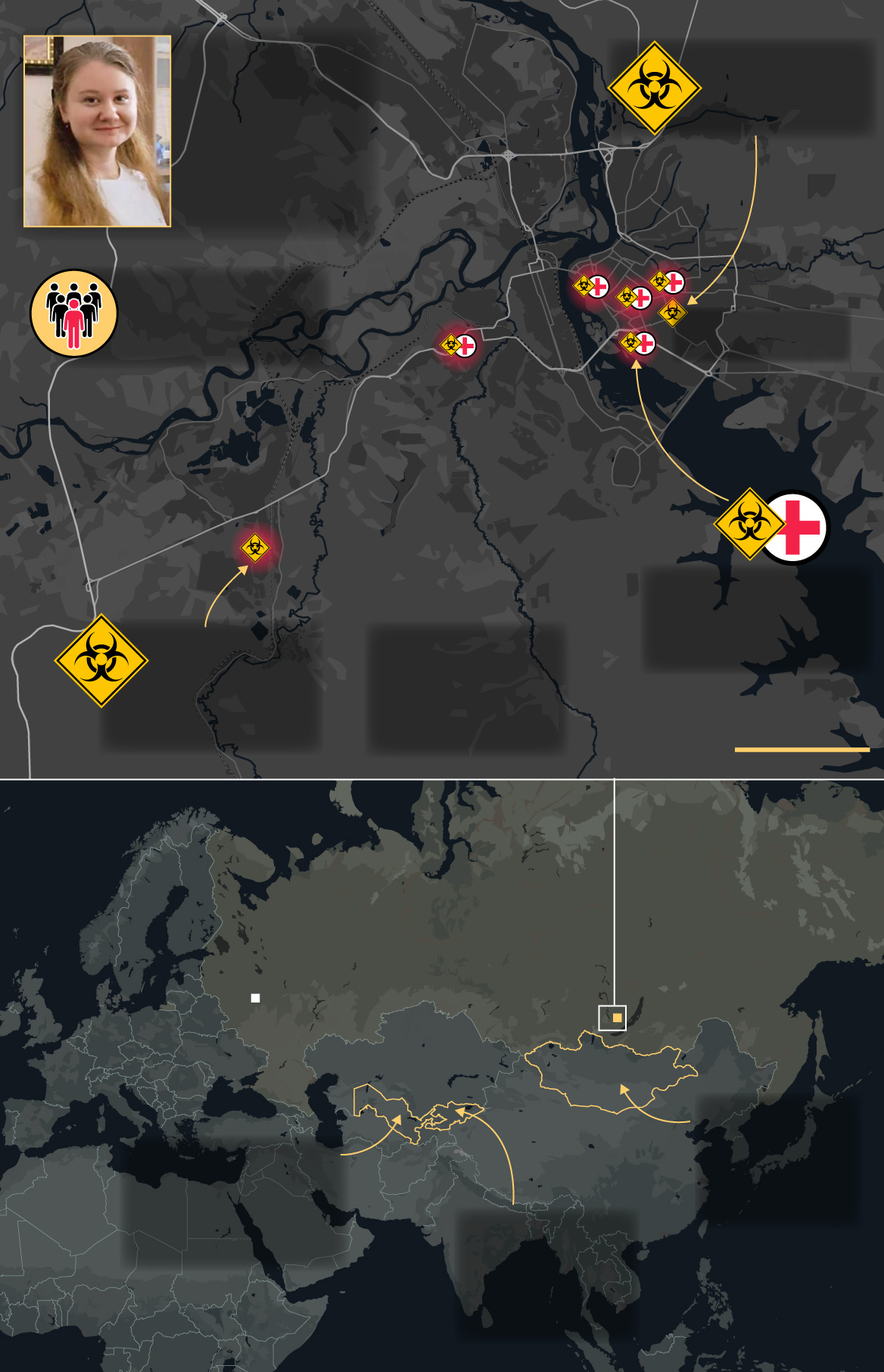
Darya Shipilova,
28, a lab
technician at
Irkutsk
Anti-Plague
Institute, dies in
Shelekhov from
pneumonic plague
60 colleagues
locked inside
institute for days
Irkutsk
Irkutsk Anti-Plague Institute
200 of Shipilova's
contacts identified
and guaranteed
Shelekhov
‘Second victim dies’
as hospitals placed in
'epidemic' mode
Staff at Irkutsk
Aluminum Plant
in Shelekhov
ordered to wear
masks
Officials in nearby
city of Baikalsk
warn against
travel to
Shelekhov
4 miles
RUSSIA
Moscow
Irkutsk
Mongolia:
High-alert
status in border
regions with
Russia
Uzbekistan:
'Measures to prevent
the importation and
spread of highly
dangerous infections'
Kyrgyzstan:
Heightened
sanitary controls
at all its border
checkpoints
https://www.dailymail.com/news/article-16186315/Russian-media-claims-second-victim-died-plague-outbreak-infection-zone-hospital-Kremlin-scrambles-cover-details.html
«Second case» of plague at Russia in 2026
Map of the panic at Moscovia for 2026.10.05 by Daily Mail
The map is loaded for the case is the original becomes unavailable.
The original (big) version is used in order to simplify the high-quality screenshot
- for the testing of the «second victim» concept.
The honest use is assumed; if reproduce for other goals then communicate the copyright owner.
In any case, the link to the original should be preserved.
Original description
Russian media claims a second victim has died from 'plague outbreak' at infection zone hospital as Kremlin scrambles to cover up details
By ELIANA SILVER, SENIOR FOREIGN NEWS REPORTER
PUBLISHED: 10:24 BST, 6 October 2026 | UPDATED: 16:55 BST, 6 October 2026
A second person has died of the plague in Russia's Irkutsk region, local media claimed on Tuesday.
Panic broke out last week when a female lab worker died after reportedly being exposed to the pneumonic plague at a research institute in Siberia.
Hundreds of people who were in contact with Darya Shipilova, 28, were placed in quarantine after the lab worker told medical staff she had accidentally broken a test tube holding live bacteria at the Irkutsk Anti-Plague Institute in Siberia. She died on October 2.
Russia insists the plague researcher died from 'unidentified pneumonia', though neighbouring countries including Mongolia, Kyrgyzstan and Uzbekistan are tightening border health controls amid reports it was the pneumonic plague.
It is feared Ms Shipilova died from the suspected Black Death bacterium – which infamously killed millions in Europe during the Middle Ages.
Now the Kremlin is scrambling to cover up the details as Russian media outlets report a second person has died at Irkutsk district hospital after allegedly contracting the plague.
Russian plague reports have allegedly been disappearing across national media, including one from Moscow's Channel 5 broadcaster and one nationally distributed daily newspaper, Kommersant.
Independent Russian outlet The Insider said on October 2 the federal television channel REN TV also deleted all five of its publications about the plague in the Irkutsk region.
The administration of Baikalsk, a city in the Irkutsk region near the Mongolian border, published a Telegram post on October 3 urging residents not to travel to the Shelekhov district.
'Due to unofficial information about a confirmed case of plague in a person in the city of Shelekhov, we ask you to limit visits to Shelekhov and nearby settlements until the circumstances surrounding this threat are clarified,' the Baykalsk city administration said in a post.
It deleted the post two hours later, independent local news outlet Lyudi Baikala reported.
Russia's press secretary Dmitry Peskov said the public should only trust updates coming from the country's official health agency, Rospotrebnadzor.
'One should rely on official statements from Rospotrebnadzor rather than listening to various rumors and speculation,' Mr Peskov said.
US Secretary of State Marco Rubio said on Monday that Washington was monitoring reports of a plague infection, but that it was not a 'cause for alarm'.
'There's very limited travel between the US and Russia, obviously, but like anything else, something like that gets out, it could quickly spread,' Mr Rubio told reporters before taking off on a visit to Iceland.
'So we're watching and monitoring it closely. I don't think it's cause for alarm – but it is cause for focus and a cause to just keep an eye on it. And we're doing that.'
Speaking on Monday, President Donald Trump revealed the US will 'help' Russia cope with the outbreak of the disease. He said: 'Well, we're looking at it very strongly. We just heard about it, and they call it pneumonia.
'And pneumonia, you know, years ago you could treat pneumonia easier. The microbes and the germs have gotten stronger disproportionately, but we'll help them.'
In response, Russia's health agency said it is ready to help the US fight outbreaks of infectious diseases such as measles.
'The Russian Federation is ready to assist the US in combating infectious disease outbreaks,' Rospotrebnadzor said in a statement.
Russia, it stressed, 'possesses extensive practical and scientific experience in ensuring epidemiological well-being, both domestically and internationally.'
It said Russia was 'prepared to provide the US side with specialists, laboratory equipment and highly effective diagnostic and preventive tools', to help address a range of worrying infectious disease outbreaks.
Among other things, it highlighted a 'significantly worsened' measles situation in three US states, and a 'fatal case of plague' recorded in New Mexico in June.
'The situation regarding dangerous infectious diseases remains unstable,' the statement said, also alleging outbreaks of typhus and Legionnaires' disease had been reported.
Meanwhile, Rospotrebnadzor has vehemently denied the existence of a plague outbreak in the region.
On October 4, the agency stated that Ms Shipilova died of 'pneumonia of an unspecified type' and assured that 'the sanitary and epidemiological situation in the Irkutsk region and the cities of Irkutsk and Shelekhov is stable'.
However, according to exiled opposition website People of Baikal, doctors in the region are speaking openly about the plague.
Locals have reported seeing people in PPE, including suits and masks, while workers at Irkutsk's aluminium factories and nursery personnel are required to wear masks.
And online searches for the word 'plague' – 'chuma' in Russian – are up 5,000 per cent from this time last year, according to The Times.
Up to five hospitals in the Irkutsk area are in 'epidemic' mode, according to reports, with hundreds of staff and patients barred from leaving.
City Clinical Hospitals No1, No3, and No10 and the Ivano-Matreninskaya Children's Hospital have been closed for a three-week quarantine, according to Lyudi Baikala.
Relatives of a woman giving birth at one of Irkutsk's maternity hospitals also reported to the outlet that it had imposed a quarantine.
Ms Shipilova became unwell while on a field expedition with colleagues in Buryatia, beside Russia's eastern border with Mongolia.
She was admitted to hospital on September 29 and placed on a ventilator but died three days later in Shelekhov, a satellite city of Irkutsk.
She came into contact with roughly 200 people, who are now being monitored over fears of an outbreak.
It has come to light that Ms Shipilova had personally worked with Yersinia pestis – the bacterium responsible for plague and the medieval Black Death – in laboratories at her workplace.
Immediately after Ms Shipilova's death, Russia's chief state sanitary doctor Anna Popova personally flew to Irkutsk to control the response to a 'particularly dangerous infection' – yet she has not spoken publicly.
Governor Alexey Tsydenov from neighbouring Buryatia initially referred to Ms Shipilova as 'the woman who died from plague', before toning it down to say she 'may have died from plague'.
Mikhail Favorov, a senior Russian epidemiologist, dismissed the broken test tube explanation, according to the Moscow Times.
Mr Favorov said: 'It's laughable. Someone working at the Anti-Plague Institute in Irkutsk wears a protective anti-plague suit.
'If you break a test tube, the likelihood of infection is actually very low. In short, it doesn't matter to the general public – they'll believe the "broken test tube" story.'
He added: 'It's absolutely hair-raising. We will not be told what really happened.'
Regional authorities are implementing a 'comprehensive set of anti-epidemic measures', according to Maxim Modin, the mayor of the Shelekhovsky district in eastern Russia, near the Mongolian border.
The inpatient facility at the hospital where the lab technician was treated has been placed under quarantine, and several departments have stopped discharging or admitting patients, Mr Modin added.
(end of copypast)
Interpretation
The abundance of contradictory publications regarding Darya Shipilova can be interpreted in three ways:
1. The Russian usurper is losing the Dvizhuha (the ongoing conflict) involving conventional weapons and is ramping up the production of biological weapons for use in combat; his accomplices are testing these weapons on the population.
2. The Russian usurper is losing the Dvizhuha
and failing in his biological weapons efforts, yet still attempts to threaten other countries by pretending to possess powerful biological weaponry.
3. The Russian usurper appoints loyal idiots to every position, including the leadership of medical centers and news agencies. The «monkey with a grenade» can destroy his own country, but no other country.
Based on the publications examined, none of the three hypotheses above can be ruled out.
The first hypothesis is the most pragmatic: it is safer to overestimate an enemy's treachery and cunning than to underestimate them.
The last hypothesis is the most optimistic regarding to stop the Dvizhuha.
References
2026.oo.oo.
https://litlife.club/books/285676/read?page=13
Даниил Гранин. Однофамилец. Page 13. ..
— Меня всегда поражало, — с жаром сказал Кузьмин. — Бомбу кидают в царя, а то, что кучер при этом гибнет, никто из этих героев не думал. Это для них мелочь, недостойная внимания… //
— А ты царя не вози… ..
https://www.dailymail.com/news/article-16186315/Russian-media-claims-second-victim-died-plague-outbreak-infection-zone-hospital-Kremlin-scrambles-cover-details.html
Russian media claims a second victim has died from 'plague outbreak' at infection zone hospital as Kremlin scrambles to cover up details //
By ELIANA SILVER, SENIOR FOREIGN NEWS REPORTER //
PUBLISHED: 10:24 BST, 6 October 2026 | UPDATED: 16:55 BST, 6 October 2026
2026.оо.оо.
https://irknipchi.ru
«Федеральное казенное учреждение здравоохранения
Иркутский ордена трудового красного знамени научно-исследовательский противочумный институт Сибири и Дальнего Востока
федеральной службы по надзору в сфере
защиты прав потребителей и благополучия человека» //
Институт учрежден приказом Уполномоченного Совета Труда и Обороны СССР № 1 от 5 июня 1934 г. как научно-оперативный орган по борьбе с чумой. В последующие годы в сферу ответственности института вошли и другие особо опасные болезни - холера, бруцеллез, туляремия, сибирская язва, арбовирусные инфекции. ..
Keywords
Bigpuf
Dvizhuha
Moscovia
Shipilova
А нас то за что?