Difference between revisions of "File:FactoriAsymptoAgreeT.png"
(misprints) |
(T uploaded a new version of File:FactoriAsymptoAgreeT.png) |
(No difference)
| |


Latest revision as of 19:48, 19 January 2026
Map of agreement \[ a(z) = - \lg \left(\frac {|z!-A(z)|} {|z!|+|A(z)|} \right) \] of the asymptotic \[ A(z)= \sqrt{2\pi z}\ \exp\left(\log\left(\frac{z}{\mathrm e} \right) z + \frac{1}{12 z}\left(1+ \frac{1}{z^2}\left(\frac{-1}{30}+ \frac{1}{z^2}\left(\frac{1}{105}+ \frac{1}{z^2}\left(\frac{-1}{140}+ \frac{1}{z^2}\left(\frac{1}{99}+ \frac{1}{z^2}\left(\frac{-1}{42} \right) \right) \right) \right) \right) \right) \right) \] with function Factorial \( z \mapsto z!\).
In the agreement \(A\), the Stirling series [1] is incorporated into the exponent rather than as a multiplicative polynomial. However, for this example, the truncated series is used; so, here, the asymptotic \(A\) is just Elementary function.
The agreement \(a=a(x\!+\!\mathrm i y)\) is shown with levels \(a=\mathrm{const}\) in the \(x,y\) plane. This agreement can be qualified as a logarithmic relative error measure [2][3].
Levels \(a\!=\!1\), \(a\!=\!3\), \(a\!=\!6\), \(a\!=\!9\), \(a\!=\!12\) are shown as thick colored curves.
The pink shade is an attempt to draw level \(a\!=\!15\). Apparently, the rounding errors of the complex double variables («double precision») do not allow to draw the smooth contour - at least with the current implementation fac.cin of the Factorial function. (If someone can do it better, go ahead!)
The picture is prepared as an example for articles «Asymptotic», «Restricted asymptotic», «Sectorial asymptotic».
Also, the map serves as test for routine Conrec6.cin; the code below can be used as an example of the driver routine (program that calls the routine).
Interpretation
The map suggests that the asymptotic \(A(z)\) above provides of order of 14 significant figures of Factorial\((z)\) in the range \[ d = (\ \Re(z) \!\ge\! -6 , \ |z|\!>\!8\ )\ \lor \ (\Re(z)\!<\!-6 , \ |\Im(z)|\!>\!5 \ ) \]
Function \(A\) is interpreted as Restricted asymptotic:
It is the Sectorial asymptotic of Factorial at large values of its argument for sector \[ D= \{ z\in \mathbf C \ : |\arg(z)|< \alpha \} \] where \(\alpha\) is any positive real number such that \( \alpha < \pi \).
At large \(|z|\), the residual \(\ r(z)\!=\)Factorial\((z)\!-\!A(z) \ \) remains asymptotically negligible compared to Factorial\((z)\) in the whole complex \(z\) plane except an arbitrarily narrow sector containing the negative real axis: \[ \lim_{|z|\to \infty, \ z \in D} \frac{r(z)}{z!} = 0 \] Here, the limit is not uniform as \(\alpha\to\pi\) . The mathematically precise version of the formula above can be written as follows: \[ \forall \alpha<\pi:\quad \lim_{|z|\to\infty,\ |\arg z|\le \alpha} \frac{r(z)}{z!}=0 \]
C++
/* Routines
«ado.cin»,
«Conrec6.cin»,
«fac.cin»
should be loaded for the compilation of the code below.
Options « -std=c++11 -O2 » are strongly recommended. */
// c++ -std=c++11 FactoriAsymptoAgree.cc -O2 -o FactoriAsymptoAgree
#include <math.h>
#include <stdio.h>
#include <stdlib.h>
#define DB double
#define DO(x,y) for(x=0;x<y;x++)
using namespace std;
#include <complex>
typedef complex<double> z_type;
#define Re(x) x.real()
#define Im(x) x.imag()
#define I z_type(0.,1.)
#include"ado.cin"
#define M(x,y) fprintf(o,"%6.4f %6.4f M\n",1.*(x),1.*(y));
#define L(x,y) fprintf(o,"%6.4f %6.4f L\n",1.*(x),1.*(y));
#include "Conrec6.cin"
#include "fac.cin"

z_type facas(z_type z){ z_type c=1./z; z_type d=c*c;
return sqrt(M_PI*2.*z)*exp(log(z/M_E)*z+(1./12.)*c*(
1.+d*(-1./30.+d*(1./105.+d*(-1./140.+d*(1./99.+d*(-1./42.)))))
));
//(1.+c*(1./12.+c*(1./288.+c*(-139./51840.))));
}

int main(){ int j,k,m,n; DB x,y, p,q, t; z_type z,c,d;
int M=251,M1=M+1;
int N=201,N1=N+1;
DB X[M1],Y[N1], g[M1*N1];
//,f[M1*N1];
FILE *o;o=fopen("FactoriAsymptoAgree.eps","w");ado(o,252,202);
fprintf(o,"151 101 translate\n 10 10 scale\n");

DO(m,M1) X[m]=-15+.1*(m-.5);
DO(n,N1) Y[n]=-10+.1*(n-.5);

DO(m,M1)DO(n,N1){g[m+M1*n]=9999;}
DO(m,M1){x=X[m]; //printf("%5.2f\n",x);
DO(n,N1){y=Y[n]; z=z_type(x,y);
// c=Filog(z);
//c=z*z*sin(1./z);
c=fac(z);
d=facas(z);
p= - log( abs(c-d) / (abs(c)+abs(d)) )/log(10.);
//p=Re(c);q=Im(c);
g[m+M1*n]=p;
       }}
fprintf(o,"1 setlinejoin 1 setlinecap\n"); p=5.;q=1;
p=15.;
Conrec6(o,g,X,Y,M1,N1, 1. ,p); fprintf(o,".12 W 1 0 0 RGB S\n");
Conrec6(o,g,X,Y,M1,N1, 2. ,p); fprintf(o,".04 W 0 0 0 RGB S\n");
Conrec6(o,g,X,Y,M1,N1, 3. ,p); fprintf(o,".12 W .6 .4 0 RGB S\n");
Conrec6(o,g,X,Y,M1,N1, 4. ,p); fprintf(o,".06 W 0 0 0 RGB S\n");
Conrec6(o,g,X,Y,M1,N1, 5. ,p); fprintf(o,".06 W 0 0 0 RGB S\n");
Conrec6(o,g,X,Y,M1,N1, 6. ,p); fprintf(o,".12 W 0 .8 0 RGB S\n");
Conrec6(o,g,X,Y,M1,N1, 7. ,p); fprintf(o,".06 W 0 0 0 RGB S\n");
Conrec6(o,g,X,Y,M1,N1, 8. ,p); fprintf(o,".06 W 0 0 0 RGB S\n");
Conrec6(o,g,X,Y,M1,N1, 9. ,p); fprintf(o,".12 W 0 .5 .6 RGB S\n");
Conrec6(o,g,X,Y,M1,N1, 10. ,p); fprintf(o,".06 W 0 0 0 RGB S\n");
Conrec6(o,g,X,Y,M1,N1, 11. ,p); fprintf(o,".06 W 0 0 0 RGB S\n");
Conrec6(o,g,X,Y,M1,N1, 12. ,p); fprintf(o,".12 W 0 0 1 RGB S\n");
Conrec6(o,g,X,Y,M1,N1, 13. ,p); fprintf(o,".06 W 0 0 0 RGB S\n");
Conrec6(o,g,X,Y,M1,N1, 14. ,p); fprintf(o,".06 W 0 0 0 RGB S\n");
Conrec6(o,g,X,Y,M1,N1, 15. ,p); fprintf(o,".07 W 1 .5 1 RGB S\n");

for(m=-10;m<11;m++){if(m!=0){M(m,-10)L(m,10)}}
for(n=-10;n<11;n++){M(-10,n)L(10,n)}
fprintf(o,"2 setlinecap .02 W 0 0 0 RGB S\n");
fprintf(o,"2 setlinecap .02 W 0 0 0 RGB S\n");
M(0,-10)L(0,11)
fprintf(o,"2 setlinecap .03 W 0 0 0 RGB S\n");

fprintf(o,"showpage\n%c%cTrailer",'%','%'); fclose(o);
     system("epstopdf FactoriAsymptoAgree.eps");
     system(    "open FactoriAsymptoAgree.pdf"); //for mac
}
Latex
%I have no idea why I have to declare paper
%sizes 803x669 in order to get picture of
%sizes 800x667
\documentclass[12pt]{article}
\usepackage{geometry}
\paperwidth 803pt
\paperheight 669pt
\textwidth 800pt
\textheight 700pt
\topmargin -106pt
\oddsidemargin -116pt
\usepackage{graphicx}
\usepackage{rotating}
\newcommand \rot {\begin{rotate}}
\newcommand \ero {\end{rotate}}
\newcommand \rme {\mathrm{e}}
\newcommand \sx {\scalebox}
\begin{document}
\sx{3.15}{\begin{picture}(230,211)
\normalsize
%\put(40,0){\ing{oblakoV}}
%\put(10,10){\includegraphics{Z2sin1zMap}}
\put(10,8){\includegraphics{FactoriAsymptoAgree}}
\put(53,204){\sx{1.2}{\(y\)}}
\put(53,185){\sx{1.1}{\(8\)}}
\put(53,165){\sx{1.1}{\(6\)}}
\put(53,145){\sx{1.1}{\(4\)}}
\put(53,125){\sx{1.1}{\(2\)}}
\put(53,105){\sx{1.1}{\(0\)}}
\put(44,85){\sx{1.1}{\(-2\)}}
\put(44,65){\sx{1.1}{\(-4\)}}
\put(44,45){\sx{1.1}{\(-6\)}}
\put(44,25){\sx{1.1}{\(-8\)}}
\put(45, 0){\sx{.9}{\(-10\)}}
\put(73, 0){\sx{.9}{\(-8\)}}
\put(93, 0){\sx{.9}{\(-6\)}}
\put(113, 0){\sx{.9}{\(-4\)}}
\put(133, 0){\sx{.9}{\(-2\)}}
\put(159, 0){\sx{.9}{\(0\)}}
\put(179, 0){\sx{.9}{\(2\)}}
\put(199, 0){\sx{.9}{\(4\)}}
\put(219, 0){\sx{.9}{\(6\)}}
\put(239, 0){\sx{.9}{\(8\)}}
\put(256, 0){\sx{1.1}{\(x\)}}
%\put(8,194){\sx{1.4}{\rot{0}\(a\!\approx\!15\) \ero} }
%\put(132,196){\sx{1.6}{\rot{0}\(a\!\approx\!15\) \ero} }
%\put(132,176){\sx{1.6}{\rot{0}\(a\!=\!14\) \ero} }
%\put(132,156){\sx{1.6}{\rot{0}\(a\!=\!12\) \ero} }

\put(185,52){\sx{1.6}{\rot{42}\(a\!=\!12\) \ero} }
\put(203,37){\sx{1.6}{\rot{40}\(a\!=\!14\) \ero} }
\put(212,19){\sx{1.6}{\rot{37}\(a\!\approx\!15\) \ero} }
\end{picture}}
\end{document}
ChatGPT
1. ChatGPT helps to improve the description of this picture.
2. Routine Conrec6.cin is used to draw lines.
This routine is tailored in collaboration with ChatGPT.
Please attribute the source at the reuse:
the attribution helps to trace bug(s) if any.
Notes by ChatGPT
Some notes by ChatGPT are not included in the description above:
The pink noise at \(a\approx 15\) is **exactly what one expects** from double precision near exponential cancellation.
When \(|z!|\gg|A(z)-z!|\), the agreement \(a(z)\) approximately equals the number of correct decimal digits in the relative sense.
The degradation near the negative real axis reflects the Stokes phenomenon associated with the logarithmic branch cut.
References
- ↑ https://mathworld.wolfram.com/StirlingsSeries.html The asymptotic series for the gamma function .. The series for z! is obtained by adding an additional factor of z, ..
- ↑ https://math.stackexchange.com/questions/1711804/why-use-the-logarithm-of-the-relative-error Why use the logarithm of the relative error? (y.2015) .. We computed the numerical solution, plotted against the given closed form solution, and and then were told to "calculate the logarithm of the maximum relative error" .. What's the idea behind taking to logarithm of this error? ..
- ↑ https://www.sciencedirect.com/topics/computer-science/relative-error Relative Error refers to a way of measuring the difference between an estimated or approximated value and the actual value, expressed as a ratio of the absolute difference to the actual value. ..
https://en.wikipedia.org/wiki/Stirling%27s_approximation In mathematics, Stirling's approximation (or Stirling's formula) is an asymptotic approximation for factorials. ..
Keywords
«[[]]», «Agreement», «Asymptotic», «ChatGPT», «Conrec6», «Elementary function», «Factorial», «Map», «Restricted asymptotic», «Sectorial asymptotic», «Stirling»,
File history
Click on a date/time to view the file as it appeared at that time.
| Date/Time | Thumbnail | Dimensions | User | Comment | |
|---|---|---|---|---|---|
| current | 19:48, 19 January 2026 | 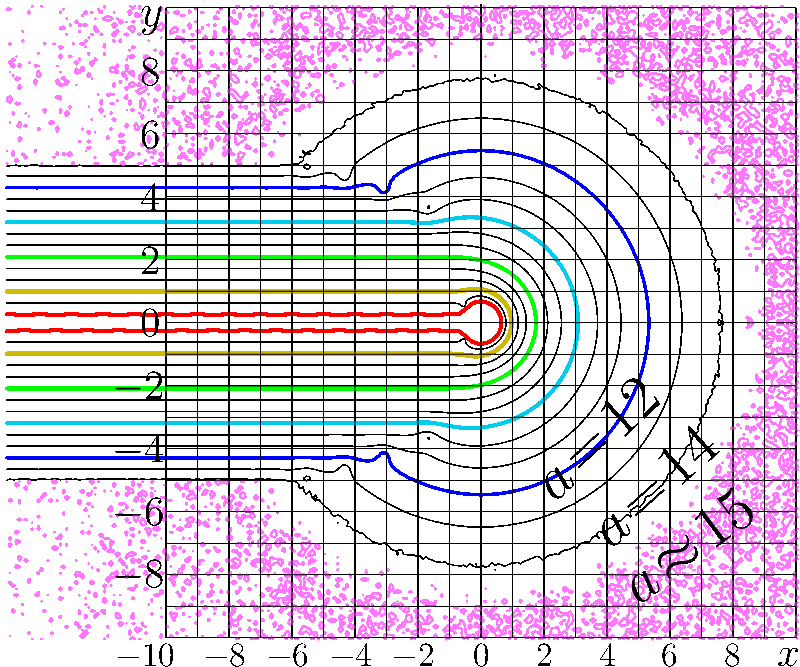 | 800 × 667 (51 KB) | T (talk | contribs) | misprint in the code had been corrected |
| 18:36, 18 January 2026 | 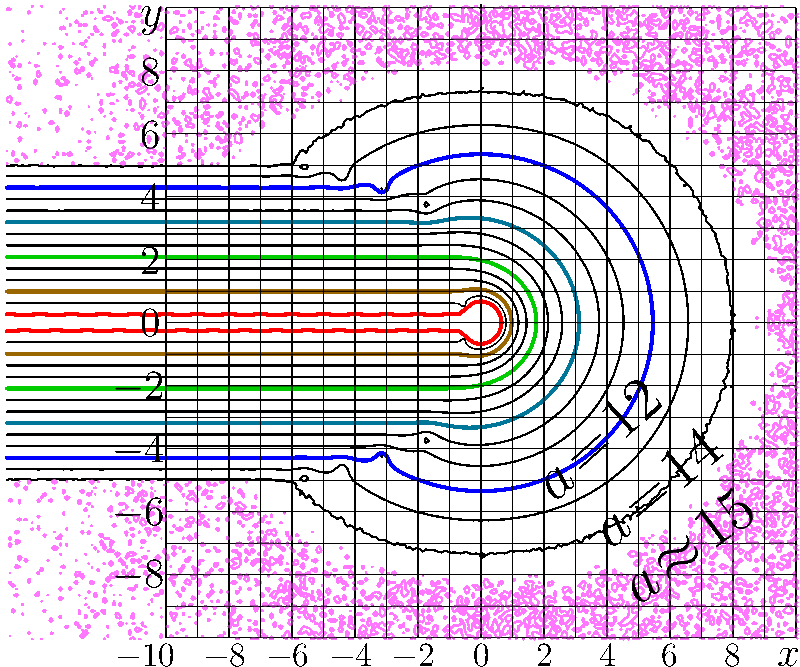 | 800 × 667 (50 KB) | T (talk | contribs) | {{oq|FactoriAsymptoAgreeT.png|Original file (800 × 667 pixels, file size: 50 KB, MIME type: image/png)|400}} Map of agreement \[ a(z) = - \lg \left(\frac {|z!-A(z)|} {|z!|+|A(z)|} \right) \] of the asymptotic \[ A(z)= \sqrt{2\pi z}\ \exp\left(\log\left(\frac{z}{\mathrm e} \right) z + \frac{1}{12 z}\left(1+ \frac{1}{z^2}\left(\frac{-1}{30}+ \frac{1}{z^2}\left(\frac{1}{105}+ \frac{1}{z^2}\left(\frac{-1}{140}+ \frac{1}{z^2}\left(\frac{1}{99}+ \frac{1}{z^2}\left(\frac{-1}{42} \right) \rig... |
You cannot overwrite this file.
File usage
The following page uses this file:
