File:SpecialMilitaryOpera540x550.jpg
SpecialMilitaryOpera540x550.jpg (540 × 550 pixels, file size: 53 KB, MIME type: image/jpeg)
Summary
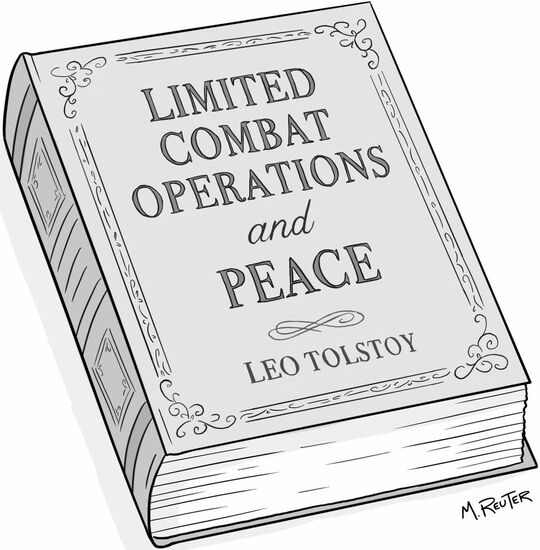
Limited military operation and peace by Leo Tolstoy
Image by the New Yorker [1], 2026
Original picture: https://media.newyorker.com/photos/69a9df183c0208c266b8e82e/master/w_1600,c_limit/A61794.jpeg

Reduction command: convert A61794.jpg[1056x1076+120+100] -resize 540 -quality 80% SpecialMilitaryOpera540x550.jpg
Original description
https://www.newyorker.com/newsletter/the-daily/the-no-explanation-war
The No-Explanation War
March 5, 2026
You’re reading The New Yorker’s daily newsletter, a guide to our top stories, featuring exclusive insights from our writers and editors. Sign up to receive it in your inbox.
In February, 2002, over a year before the U.S. invasion of Iraq, Donald Rumsfeld stood in front of news cameras at the Pentagon and laid out his now infamous word contraption about “known knowns,” “known unknowns,” and “unknown unknowns.” He was responding to a reporter’s question about the lack of evidence that Saddam Hussein possessed weapons of mass destruction. Today, as Donald Trump’s war in Iran reaches its sixth day, the idea that a senior Administration official would feel the need to justify military action feels both anachronistic and almost cute.
In this week’s edition of my column, Fault Lines, I wrote about how the Trump Administration’s policy of shoot first and don’t answer questions later might be a conscious effort to circumvent or perhaps even erase the country’s collective memories of the wars in Afghanistan and Iraq. It’s long been conventional wisdom that the public would never approve of yet another interminable conflict in the Middle East. What the Trump Administration seems to be asking is, “What if we just skipped over the entire approval process?”
Earlier this week, my colleague Susan B. Glasser asked a similar question in her weekly column: “Can the U.S. win a war of its choosing when it cannot explain why it chose to fight or what, exactly, victory would mean?” And for those who, like me, woke up this past Saturday morning and asked, “Can the President even declare war on his own?” the historian Jill Lepore provides a thorough and informative answer. Congress certainly doesn’t seem interested in making decisions on military action. Ruth Marcus argues today that, with this latest attack, it has fully ceded its legislative authority, leaving seemingly no checks on the executive whatsoever. She warns: “The Framers would have found this chilling.”
Read Jay Caspian Kang’s column
Daily Cartoon
A hardcover books title reads “Limited Combat Operations and Peace” by Leo Tolstoy.
Ian Crouch contributed to today’s edition.
Jay Caspian Kang, a staff writer at The New Yorker, is the author of “The Loneliest Americans.”
References
- ↑ https://www.newyorker.com/newsletter/the-daily/the-no-explanation-war The No-Explanation War By Jay Caspian Kang March 5, 2026
Keywords
«Annexation of Canada», «Annexation of Greenland», «Collapse of USA», «Donald Trump», «Donroe Doctrine», «EpicFury», «Epic Fury», «Jay Caspian Kang», «Leo Tolstoy», «New World Order», «New Yorker», «Propaganda», «Putin world war», «Propaganda», «Small Victorious War», «Small victorious war», «Tolstoi Lev Nikolaevich», «TROI», «Trump as KGB agent», «USA», «Witkoff Statement on Iranian Uranium Stockpiles», «Witkoff-Lavrov Pact»,
«А нас то за что», «Маленькая победоносная война», «Новый Мировой Порядок», «Трамп Дональд Фредович»,
File history
Click on a date/time to view the file as it appeared at that time.
| Date/Time | Thumbnail | Dimensions | User | Comment | |
|---|---|---|---|---|---|
| current | 08:18, 14 March 2026 | | 540 × 550 (53 KB) | T (talk | contribs) | == Summary == {{oq|SpecialMilitaryOpera540x550.jpg|SpecialMilitaryOpera540x550.jpg (540 × 550 pixels, file size: 53 KB, MIME type: image/jpeg)|}} Limited military operation and peace by Leo Tolstoy Image by the New Yorker <ref> https://www.newyorker.com/newsletter/the-daily/the-no-explanation-war The No-Explanation War By Jay Caspian Kang March 5, 2026 </ref>, 2026 Original picture: https://media.newyorker.com/photos/69a9df183c0208c266b8e82e/master/w_1600,c_limit/A61794.jpeg Reducti... |
You cannot overwrite this file.
File usage
The following 2 pages use this file:
