File:DoyaPlotT100.png



Original file (834 × 848 pixels, file size: 338 KB, MIME type: image/png)
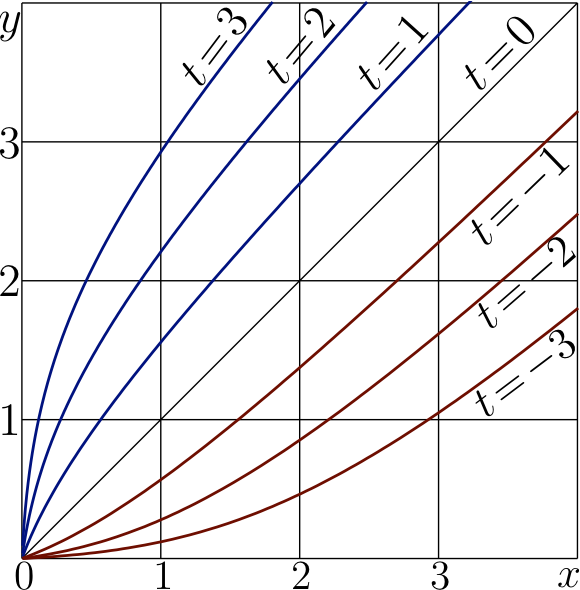
Explicit plot of the Doya function
\( \mathrm{Doya}^n(z)=\mathrm{Tania}(n+\mathrm{ArcTania}(z))\)
where the Tania function is solution of equations
\(\displaystyle \mathrm{Tania}'(z)= \frac{ \mathrm{Tania}(z)}{1\!+\!\mathrm{Tania}(z)}~\), \(~\mathrm{Tania}(0)\!=\!1\)
At the picture, \(y=\mathrm{Doya}^n(x)\) is plotted versus \(x\) for various values of \(n\).
The picture is used as Fig.5.6 at page 52 of book «Superfunctions»[1][2]
in order to show that the iterates are with the simple example
related to the Laser science.
Generators
The curves are generated with the C++ code. The resulting file is imported into the Latex document for generation of labels. The resulting *.pdf is converted to *.png for the portability.
C++ generator of curves
#include <math.h>
#include <stdio.h>
#include <stdlib.h>
#define DB double
#define DO(x,y) for(x=0;x<y;x++)
// using namespace std;
#include <complex>
typedef std::complex<double> z_type;
#define Re(x) x.real()
#define Im(x) x.imag()
#define I z_type(0.,1.)
z_type ArcTania(z_type z) {return z + log(z) - 1. ;}
z_type ArcTaniap(z_type z) {return 1. + 1./z ;}
z_type TaniaTay(z_type z) { int n; z_type s;
s=1.+z*(.5+z*(1./16.+z*(-1./192.+z*(-1./3072.+z*(1.3/6144.+z*(-4.7/147456.
//+z*(7.3/4128768.) //some reserve term
)))))); DO(n,3) s+=(z-ArcTania(s))/ArcTaniap(s); return s ; }
z_type TaniaNega(z_type z){int n;z_type s=exp(z-exp(z)+1.);
DO(n,4) s+=(z-ArcTania(s))/ArcTaniap(s); return s ; }
z_type TaniaBig(z_type z){int n;z_type s=z; s=z-log(s)+1.;
DO(n,3) s+=(z-ArcTania(s))/ArcTaniap(s); return s ; }
z_type TaniaS(z_type z){int n; z_type s,t=z+z_type(2.,-M_PI);t*=2./9.; t=I*sqrt(t);
s=-1.+t*(3.+t*(-3.+t*(.75+t*(.3+t*(.9/16.+t*(-.3/7.+t*(-12.51/224. //+t*(-.9/28.)
)))))));
DO(n,3) s+=(z-ArcTania(s))/ArcTaniap(s); return s ; }
z_type Tania(z_type z){ z_type t;
if( fabs(Im(z))< M_PI && Re(z)<-2.51) return TaniaNega(z);
if( abs(z)>7. || Re(z)>3.8 ) return TaniaBig(z);
if( Im(z) > .7 ) return TaniaS(z);
if( Im(z) < -.7) return conj(TaniaS(conj(z)));
return TaniaTay(z);
}
void ado(FILE *O, int X, int Y)
{      fprintf(O,"%c!PS-Adobe-2.0 EPSF-2.0\n",'%');
      fprintf(O,"%c%cBoundingBox: 0 0 %d %d\n",'%','%',X,Y);
      fprintf(O,"/M {moveto} bind def\n");
      fprintf(O,"/L {lineto} bind def\n");
      fprintf(O,"/S {stroke} bind def\n");
      fprintf(O,"/s {show newpath} bind def\n");
      fprintf(O,"/C {closepath} bind def\n");
      fprintf(O,"/F {fill} bind def\n");
      fprintf(O,"/o {.1 0 360 arc C S} bind def\n");
      fprintf(O,"/times-Roman findfont 20 scalefont setfont\n");
      fprintf(O,"/W {setlinewidth} bind def\n");
      fprintf(O,"/RGB {setrgbcolor} bind def\n");}
#define M(x,y) fprintf(o,"%6.3f %6.3f M\n",0.+x,0.+y);
#define L(x,y) fprintf(o,"%6.3f %6.3f L\n",0.+x,0.+y);
int main(){ int j,k,m,n; DB x,y, a;
FILE *o;o=fopen("doyaplo.eps","w");ado(o,408,408);
fprintf(o,"4 4 translate\n 100 100 scale\n");
for(m=0;m<5;m++){ M(m,0)L(m,4)}
for(n=0;n<5;n++){ M(0,n)L(4,n)}
M(0,0)L(4,4)
fprintf(o,".01 W 0 0 0 RGB S\n");

DO(n,181){x=.005+.01*n;y=Re(Tania(6.+ArcTania(x)));if(n==0)M(x,y)else L(x,y) if(y>4.) break;} fprintf(o,".02 W 0 .3 1 RGB S\n");
DO(n,181){x=.005+.01*n;y=Re(Tania(5.+ArcTania(x)));if(n==0)M(x,y)else L(x,y) if(y>4.) break;} fprintf(o,".02 W 0 .3 1 RGB S\n");
DO(n,181){x=.005+.01*n;y=Re(Tania(4.+ArcTania(x)));if(n==0)M(x,y)else L(x,y) if(y>4.) break;} fprintf(o,".02 W 0 .3 1 RGB S\n");
DO(n,181){x=.005+.01*n;y=Re(Tania(3.+ArcTania(x)));if(n==0)M(x,y)else L(x,y)} fprintf(o,".02 W 0 .3 1 RGB S\n");
DO(n,249){x=.005+.01*n;y=Re(Tania(2.+ArcTania(x)));if(n==0)M(x,y)else L(x,y)} fprintf(o,".02 W 0 .3 1 RGB S\n");
DO(n,163){x=.005+.02*n;y=Re(Tania(1.+ArcTania(x)));if(n==0)M(x,y)else L(x,y)} fprintf(o,".02 W 0 .3 1 RGB S\n");
DO(n,101){x=.005+.04*n;y=Re(Tania(-1.+ArcTania(x)));if(n==0)M(x,y)else L(x,y)} fprintf(o,".02 W 1 .3 0 RGB S\n");
DO(n,101){x=.005+.04*n;y=Re(Tania(-2.+ArcTania(x)));if(n==0)M(x,y)else L(x,y)} fprintf(o,".02 W 1 .3 0 RGB S\n");
DO(n,101){x=.005+.04*n;y=Re(Tania(-3.+ArcTania(x)));if(n==0)M(x,y)else L(x,y)} fprintf(o,".02 W 1 .3 0 RGB S\n");
DO(n,101){x=.005+.04*n;y=Re(Tania(-4.+ArcTania(x)));if(n==0)M(x,y)else L(x,y)} fprintf(o,".02 W 1 .3 0 RGB S\n");
DO(n,101){x=.005+.04*n;y=Re(Tania(-5.+ArcTania(x)));if(n==0)M(x,y)else L(x,y)} fprintf(o,".02 W 1 .3 0 RGB S\n");
DO(n,101){x=.005+.04*n;y=Re(Tania(-6.+ArcTania(x)));if(n==0)M(x,y)else L(x,y)} fprintf(o,".02 W 1 .3 0 RGB S\n");

DO(m,61)
 {  a=-3.+.1*m;  DO(n,400){x=.005+.01*n;y=Re(Tania(a+ArcTania(x)));if(n==0)M(x,y)else L(x,y) if(y>4.) break; }
 }
fprintf(o,".005 W 0 0 0 RGB S\n");

fprintf(o,"showpage\n%cTrailer",'%'); fclose(o);
     system("epstopdf doyaplo.eps");
     system(    "open doyaplo.pdf"); //these 2 commands may be specific for macintosh
getchar(); system("killall Preview");// if run at another operational sysetm, may need to modify
}
Latex generator of the picture
\documentclass[12pt]{article}
\usepackage{geometry}
\usepackage{graphicx}
\usepackage{rotating} %<br>
\paperwidth 419pt %<br>
\paperheight 426pt %<br>
\topmargin -103pt %<br>
\oddsidemargin -83pt %<br>
\textwidth 1200pt %<br>
\textheight 600pt %<br>
\pagestyle {empty} %<br>
\newcommand \sx {\scalebox} %<br>
\newcommand \rot {\begin{rotate}} %<br>
\newcommand \ero {\end{rotate}} %<br>
\newcommand \ing {\includegraphics} %<br>
\begin{document} %<br>
\sx{1}{ \begin{picture}(810,410) %<br>
\put(1,9){\ing{doyaplo}} % <br>
\put(-12,394){\sx{2.8}{$y$}}
\put(-12,303){\sx{2.8}{$3$}}
\put(-12,203){\sx{2.8}{$2$}}
\put(-12,103){\sx{2.8}{$1$}}
\put(0,-9){\sx{2.5}{$0$}}
\put(100,-9){\sx{2.5}{$1$}}
\put(200,-9){\sx{2.5}{$2$}}
\put(300,-9){\sx{2.5}{$3$}}
\put(392,-7){\sx{2.6}{$x$}}
 %\put(560,214){\rot{37}\sx{4}{$y=\mathrm{Tania}(x)$}\ero}
\put(30,342){\rot{74}\sx{2.8}{$n\!=\!6$}\ero}
\put(54,342){\rot{68}\sx{2.8}{$n\!=\!5$}\ero}
\put(90,346){\rot{55}\sx{2.8}{$n\!=\!4$}\ero}
\put(146,348){\rot{53}\sx{2.8}{$n\!=\!3$}\ero}
\put(210,350){\rot{50}\sx{2.8}{$n\!=\!2$}\ero}
\put(270,340){\rot{48}\sx{2.8}{$n\!=\!1$}\ero}
\put(324,318){\rot{45}\sx{3.0}{$n\!=\!0$}\ero}
\put(332,252){\rot{43}\sx{2.8}{$n\!=\!-1$}\ero}
\put(332,184){\rot{40}\sx{2.8}{$n\!=\!-2$}\ero}
\put(332,125){\rot{36}\sx{2.8}{$n\!=\!-3$}\ero}
\put(328,75){\rot{30}\sx{2.8}{$n\!=\!-4$}\ero}
\put(320,36){\rot{22}\sx{2.8}{$n\!=\!-5$}\ero}
\end{picture} %<br>
} %<br>
\end{document}
Copyleft status
This picture and its generators can be used for free; attribute the source.
References
- ↑ https://www.amazon.co.jp/Superfunctions-Non-integer-holomorphic-functions-superfunctions/dp/6202672862 Dmitrii Kouznetsov. Superfunctions: Non-integer iterates of holomorphic functions. Tetration and other superfunctions. Formulas,algorithms,tables,graphics ペーパーバック – 2020/7/28
- ↑ https://mizugadro.mydns.jp/BOOK/468.pdf Dmitrii Kouznetsov (2020). Superfunctions: Non-integer iterates of holomorphic functions. Tetration and other superfunctions. Formulas, algorithms, tables, graphics. Publisher: Lambert Academic Publishing.
Keywords
«[[]]», «[[]]», «Doya function», «Iterate», «Superfunction», «Superfunctions», «Tania function», «Transfer function»,
«Суперфункции»,
File history
Click on a date/time to view the file as it appeared at that time.
| Date/Time | Thumbnail | Dimensions | User | Comment | |
|---|---|---|---|---|---|
| current | 18:18, 18 August 2025 | | 834 × 848 (338 KB) | T (talk | contribs) | add more lines - as in the Book |
| 17:50, 20 June 2013 |  | 580 × 590 (77 KB) | Maintenance script (talk | contribs) | Importing image file |
You cannot overwrite this file.
File usage
The following 2 pages use this file:
