Difference between revisions of "File:SuTraAsyQ2ateT.png"
m (mistake with color) |
m (→Keywords: zex) |
||
| (4 intermediate revisions by the same user not shown) | |||
| Line 1: | Line 1: | ||
{{oq|SuTraAsyQ2ateT.png|Original file (644 × 1,235 pixels, file size: 28 KB, MIME type: image/png)|600}} |
{{oq|SuTraAsyQ2ateT.png|Original file (644 × 1,235 pixels, file size: 28 KB, MIME type: image/png)|600}} |
||
| − | [[Explicit plot]] of the |
+ | [[Explicit plot]] of the generalized [[Asymptotic]] «Asym» <span style="background-color:#6ff">(thick light blue (Cyan) curve)</span> of function [[SuTra]] |
| − | <span style="background-color:#F6F">(pink curve)</span> through the growing [[SuperExponential]] to [[base sqrt2|base \(\sqrt{2}\)]] |
+ | <span style="background-color:#F6F">(pink curve)</span> through the growing [[SuperExponential]] to [[base sqrt2|base \(\sqrt{2}\ \)]]; some related functions are also shown. |
==Asymptotic statement== |
==Asymptotic statement== |
||
| Line 41: | Line 41: | ||
<span style="background-color:#5ff"><big><b>Light blue (cyan) curve:</b></big></span> |
<span style="background-color:#5ff"><big><b>Light blue (cyan) curve:</b></big></span> |
||
| − | \(\ y=\mathrm{Asym}(x) = \mathrm{SuExp}_{\sqrt{2},4,5}(x\! |
+ | \(\ y=\mathrm{Asym}(x) = \mathrm{SuExp}_{\sqrt{2},4,5}(x\!+\!x_{\mathrm{stq2}}) \) . This is [[ArctetralAsymptotic]] of function [[SuTra]] with growing [[SuperExponential]] to [[base sqrt2|base \(\sqrt{2}\)]] at large input. This growing [[SuperExponential]] \(\mathrm{SuExp}_{\sqrt{2},4,5}\) |
is described at [[Mathematics of Computation]] <ref> |
is described at [[Mathematics of Computation]] <ref> |
||
http://www.ams.org/journals/mcom/2010-79-271/S0025-5718-10-02342-2/home.html <br> |
http://www.ams.org/journals/mcom/2010-79-271/S0025-5718-10-02342-2/home.html <br> |
||
| Line 85: | Line 85: | ||
https://mizugadro.mydns.jp/BOOK/202.pdf (Russian version, 2014)<br> |
https://mizugadro.mydns.jp/BOOK/202.pdf (Russian version, 2014)<br> |
||
https://mizugadro.mydns.jp/BOOK/468.pdf (Engish version, 2020). |
https://mizugadro.mydns.jp/BOOK/468.pdf (Engish version, 2020). |
||
| − | Dmitrii |
+ | Dmitrii Kouznetsov. [[Superfunctions]]. [[Lambert Academic Publishing]], 2020 |
</ref>, 2014,2020. |
</ref>, 2014,2020. |
||
| + | At \(\ x \to +\infty\ \), the tangent of each of the two curves<br> |
||
| − | The green and blue curves approach the same straight line, indicating the asymptotic equivalence. |
||
| + | \(\ y=\mathrm{ate}\!\big(\mathrm{Asym}(x)\big)\ \) <span style="color:#00D">(blue)</span> and<br> |
||
| − | This line is approximated with \(\ y=x\!-\!0.7 \ \). |
||
| + | \(\ y=\mathrm{ate}\!\big(\mathrm{SuTra}(x)\big) \ \) <span style="background-color:#7f0">(green)</span><br> |
||
| + | approach unity. |
||
| + | The constant shift \(x_{\mathrm{stq2}}\) is chosen in such a way that these curves |
||
| + | approach the same straight line \(\ y\!=\!x\!-\!C\ \), where \(C\) is constant. |
||
| + | This constant is estimated numerically; roughly, \(\ C\!\approx \!0.7 \ \). |
||
| + | Dependence \(\ y\!=\!x\!-\!0.7 \ \) is shown with thin line. At the right edge of the picture, these two curves and this straight line are already very close, the deviation becomes smaller than the thickness of the lines. |
||
<span style="color:#C00"><big><b>Red curve:</b></big></span> \( \ y=\delta(x) \ \); it is arctetral residual |
<span style="color:#C00"><big><b>Red curve:</b></big></span> \( \ y=\delta(x) \ \); it is arctetral residual |
||
| Line 221: | Line 227: | ||
%\put(24,119){\sx{3}{\rot{22}\(y\!=\!\mathrm{SuTra}(x)\)\ero}} |
%\put(24,119){\sx{3}{\rot{22}\(y\!=\!\mathrm{SuTra}(x)\)\ero}} |
||
%\put(488,633){\sx{3.4}{\rot{44}\(y=x\!+\!x_{\mathrm{ste2}}\)\ero}} |
%\put(488,633){\sx{3.4}{\rot{44}\(y=x\!+\!x_{\mathrm{ste2}}\)\ero}} |
||
| − | \put(270,208){\sx{3.4}{\rot{44}\(y=x\! |
+ | \put(270,208){\sx{3.4}{\rot{44}\(y=x\!-\!0.7\)\ero}} |
\put(298,160){\sx{4}{\rot{47}\(y\!=\!\mathrm{ate}\!\big(\mathrm{SuTra}(x)\big)\)\ero}} |
\put(298,160){\sx{4}{\rot{47}\(y\!=\!\mathrm{ate}\!\big(\mathrm{SuTra}(x)\big)\)\ero}} |
||
%\put(440,56){\sx{4}{\rot{84}\(y\!=\!\mathrm{AuExp_{\sqrt{2},4,5}}\big(\mathrm{SuTra}(x)\big)\)\ero}} |
%\put(440,56){\sx{4}{\rot{84}\(y\!=\!\mathrm{AuExp_{\sqrt{2},4,5}}\big(\mathrm{SuTra}(x)\big)\)\ero}} |
||
| Line 230: | Line 236: | ||
\end{document} |
\end{document} |
||
</pre> |
</pre> |
||
| + | |||
| + | ==Attribution== |
||
| + | 1. [[ChatGPT]] helps to improve the description above. |
||
| + | |||
| + | 2. At the reuse of the picture and/or its generator, please, attribute the source.<br> |
||
| + | The attribution helps to trace mistakes, if any. |
||
==References== |
==References== |
||
| Line 235: | Line 247: | ||
{{fer}} |
{{fer}} |
||
| + | |||
==Keywords== |
==Keywords== |
||
«[[Abelfunction]]», |
«[[Abelfunction]]», |
||
«[[Approximation]]», |
«[[Approximation]]», |
||
| − | «[[Arctetral |
+ | «[[Arctetral asymptotic]]», |
«[[Asymptotic]]», |
«[[Asymptotic]]», |
||
«[[Base sqrt2]]», |
«[[Base sqrt2]]», |
||
| Line 256: | Line 269: | ||
«[[Tania.cin]]», |
«[[Tania.cin]]», |
||
«[[LambertW.cin]]», |
«[[LambertW.cin]]», |
||
| − | «[[SuZex.cin]]» (Function [[SuTra]] is implemented through function [[SuZex]]\( = z\mapsto z\ \exp(z)\)), |
+ | «[[SuZex.cin]]» (Function [[SuTra]] is implemented through function [[SuZex]]; zex\( = z\mapsto z\ \exp(z)\)), |
«[[Sqrt2f45e.cin]]» (C++ implementation of growing [[SuperExponential]] to [[base sqrt2]]), |
«[[Sqrt2f45e.cin]]» (C++ implementation of growing [[SuperExponential]] to [[base sqrt2]]), |
||
«[[Sqrt2f45l.cin]]» (C++ implementation of growing [[AbelExponential]] to [[base sqrt2]]) |
«[[Sqrt2f45l.cin]]» (C++ implementation of growing [[AbelExponential]] to [[base sqrt2]]) |
||
| Line 263: | Line 276: | ||
[[Category:Arctetral asymptotic]] |
[[Category:Arctetral asymptotic]] |
||
[[Category:Asymptotic]] |
[[Category:Asymptotic]] |
||
| − | [[Category:Atemptotic]] |
||
[[Category:Explicit plot]] |
[[Category:Explicit plot]] |
||
[[Category:Logarithmic asymptotic]] |
[[Category:Logarithmic asymptotic]] |
||


Latest revision as of 10:04, 5 February 2026
Explicit plot of the generalized Asymptotic «Asym» (thick light blue (Cyan) curve) of function SuTra (pink curve) through the growing SuperExponential to base \(\sqrt{2}\ \); some related functions are also shown.
Asymptotic statement
For real \(x\to +\infty\), \(x>0\), \[ \mathrm{SuTra}(x) \ \underset{\overset{x\to+\infty}{x>0}}{\overset{\mathrm{ate}}{\sim}} \mathrm{Asym}(x) \, , \qquad \mathrm{Asym}(x)= \mathrm{SuExp}_{\sqrt{2},4,5}(x+x_{\mathrm{stq2}}), \] where the shift constant is numerically estimated as \[ x_{\mathrm{stq2}}\approx 1.219 \]
By definition, this means \[ \lim_{x\to+\infty} \Big( \mathrm{ate}\!\big(\mathrm{SuTra}(x)\big) - \mathrm{ate}\!\big(\mathrm{Asym}(x)\big) \Big) =0. \]
Description of the curves
Pink curve: \(\ y=\mathrm{SuTra}(x)\), the superfunction of the Trappmann map \(z\mapsto z+\exp z\). SuTra is Entire Function with Logarithmic Asymptotic, it is described at the Applied Mathematical Sciences [1], 2013.
Light blue (cyan) curve: \(\ y=\mathrm{Asym}(x) = \mathrm{SuExp}_{\sqrt{2},4,5}(x\!+\!x_{\mathrm{stq2}}) \) . This is ArctetralAsymptotic of function SuTra with growing SuperExponential to base \(\sqrt{2}\) at large input. This growing SuperExponential \(\mathrm{SuExp}_{\sqrt{2},4,5}\) is described at Mathematics of Computation [2], 2010. In this calculus, the following evaluate of the parameter is used: \( x_{\mathrm{stq2}}\!\approx\! 1.219 \ \). In the routine below, identifier "Shift" is used for this parameter. The last digit of this estimate is subject for the revision (and perhaps the correction).
Green curve: \(\ y=\mathrm{ate}\!\big(\mathrm{SuTra}(x)\big)\), the ArcTetrational "image" of SuTra. The natural ArcTetration \(\mathrm{ate}\) is described at Mathematics of Computation [3], 2009; the efficient implementations of the natural tetration \(\mathrm{tet}\) and that of the natural ArcTetration \(\mathrm{ate}\) are described at Vladikavkaz Mathematical Journal [4], 2010. Even improved algorithms to evaluate the tetration and arctetration are suggested also by William Paulsen and Samuel Patrick Cowgill [5][6][7], but, up to year 2026, the C++ implementations for these algorithms are not found in the free access.
Thin black curve at the left hand side: \( y=-\ln(-x)\), it is asymptotic of function SuTra at large negative input.
Dark blue curve: \(\ y=\mathrm{ate}\!\big(\mathrm{Asym}(x)\big)\), the ArcTetrational image of the asymptotic function.
The functions mentioned above (except the «Asym») are described also in book «Superfunctions» [8], 2014,2020.
At \(\ x \to +\infty\ \), the tangent of each of the two curves
\(\ y=\mathrm{ate}\!\big(\mathrm{Asym}(x)\big)\ \) (blue) and
\(\ y=\mathrm{ate}\!\big(\mathrm{SuTra}(x)\big) \ \) (green)
approach unity.
The constant shift \(x_{\mathrm{stq2}}\) is chosen in such a way that these curves
approach the same straight line \(\ y\!=\!x\!-\!C\ \), where \(C\) is constant.
This constant is estimated numerically; roughly, \(\ C\!\approx \!0.7 \ \).
Dependence \(\ y\!=\!x\!-\!0.7 \ \) is shown with thin line. At the right edge of the picture, these two curves and this straight line are already very close, the deviation becomes smaller than the thickness of the lines.
Red curve: \( \ y=\delta(x) \ \); it is arctetral residual \(\ \delta(x)= \mathrm{ate}\!\big(\mathrm{SuTra}(x)\big) - \mathrm{ate}\!\big(\mathrm{Asym}(x)\big)\, \); it tends to zero and quantifies the precision of the asymptotic approximation.
The additional short grid line \(\ y=\mathrm e\!+\!1 = \mathrm{SuTra}(2) \ \) marks the specific value of the SuperTrappmann function at the integer input.
C++
/* subroutines ado.cin, Tania.cin, LambertW.cin, SuZex.cin, fslog.cin should be loaded in order to compile the source below.*/
 #include <math.h>
 #include <stdio.h>
 #include <stdlib.h>
 #define DB double
 #define DO(x,y) for(x=0;x<y;x++)
 using namespace std;
 #include<complex>
 typedef complex<double> z_type;
 #define Re(x) x.real()
 #define Im(x) x.imag()
 #define I z_type(0.,1.)
 #include "Tania.cin" // need for LambertW
 #include "LambertW.cin" // need for AuZex
 #include "SuZex.cin"
  #include "Sqrt2f45e.cin"
  #include "Sqrt2f45l.cin"
  #include "fslog.cin"
 z_type tra(z_type z){ return exp(z)+z;}
 z_type sutra(z_type z){ if( Re(z)<2. || fabs(Im(z))>2. ) return log(suzex(z));
                                                          return tra(sutra(z-1.));}
DB Shift=1.219;
z_type Asym(z_type z){ return F45E(z+Shift); }
#include "ado.cin"
#define M(x,y) fprintf(o,"%6.4f %6.4f M\n",0.+x,0.+y);
#define L(x,y) fprintf(o,"%6.4f %6.4f L\n",0.+x,0.+y);
int main(){ int j,k,m,n; DB x,y, p,q, t; z_type z,c,d;
FILE *o;o=fopen("SuTraAsyQ2ate.eps","w"); ado(o,622,1212); fprintf(o,"202 202 translate\n 100 100 scale 1 setlinejoin 2 setlinecap\n");
 DO(m,411){x=-2.02+.02*m; y=Re(sutra(x)); if(m==0) M(x,y) else L(x,y) if(x>6.03||y>10) break;} fprintf(o,".06 W 1 0 1 RGB S\n");
 DO(m,100){x=-2.01+.02*m; y=-log(-x);     if(m==0) M(x,y) else L(x,y) if(x>6.03||y>10) break;} fprintf(o,".01 W 0 0 0 RGB S\n");
 DO(m,720){x=-2.1+.01*m;  z=sutra(x);
	if(!(abs(z)<1.e32)) {
		// printf("%lg %lg %lg\n",x,Re(z),Im(z));
		break;
		}
	   z=FSLOG(z); y=Re(z);	//printf("%6.3lf %16.14lf \n",x,Re(z));
	if(m==0) M(x,y) else L(x,y) 	if(x>4.4||y>10) break;
	} fprintf(o,".06 W 0 1 0 RGB S\n");

 DO(m,720){x=-2.1+.01*m;  z=Asym(x);
	if(!(abs(z)<1.e32)) { 		// printf("%lg %lg %lg\n",x,Re(z),Im(z));
				break;		}
	//   z=F45L(z); y=Re(z);
	   z=FSLOG(z); y=Re(z); //printf("%6.3lf %16.14lf \n",x,Re(z));
	if(m==0) M(x,y) else L(x,y) 	if(x>4.4||y>10) break;
	} fprintf(o,".04 W 0 0 1  RGB S\n");

 DO(m,637){x=-2.1+.01*m; c=FSLOG(sutra(x)); d=FSLOG(Asym(x)); y=Re((c-d)); if(m==0) M(x,y) else L(x,y); }
fprintf(o,".03 W 1 0 0 RGB S\n");


DO(m,84){ x=-2.1+.1*m; z=Asym(x); y=Re(z); if(m==0) M(x,y) else L(x,y); if(y>10) break; }  fprintf(o,".09 W 0 1 1 RGB S\n");

 for(n=-2;n<11;n++) {M(-2,n)L(4,n)}
 for(m=-2;m<5;m++) {M(m,-2)L(m,10)}   M(0,1.+M_E) L(2,1.+M_E)
M(-1,-1.7)L(5,5-.7)fprintf(o,"0 0 0 RGB .004 W S\n");
M(0,-2.1)L(0,10.1)
M(-2.1,0)L(6.1,0) fprintf(o,".03 W S\n");

fprintf(o,"showpage\n"); fprintf(o,"%c%cTrailer\n",'%','%');  fclose(o);
      system("epstopdf SuTraAsyQ2ate.eps");
      system(    "open SuTraAsyQ2ate.pdf"); //for macintosh
return 0;
Latex
\documentclass[12pr]{article}
\paperwidth 646pt
\paperheight 1240pt
\textwidth 800pt
\textheight 1700pt
\topmargin -96pt
\oddsidemargin -66pt
%\usepackage{xcolor}
\usepackage{graphicx}
\usepackage{rotating}
\newcommand \sx {\scalebox}
\newcommand \ing {\includegraphics}
\newcommand \rot {\begin{rotate}}
\newcommand \ero {\end{rotate}}
\parindent 0pt
\begin{document}
\begin{picture}(720,1220)
%\put(-2,-6){\textcolor{white}{\rule{740pt}{740pt}}}
%\put(20,20){\ing{SuTraAsy3plot}}
%\put(20,20){\ing{SuTraAsyQplot}}
\put(20,20){\ing{SuTraAsyQ2ate}}
\put( 3,1206){\sx{3.2}{\(y\)}}
\put( 4,1116){\sx{3}{\(9\)}}
\put( 4,1016){\sx{3}{\(8\)}}
\put( 4,916){\sx{3}{\(7\)}}
\put( 4,816){\sx{3}{\(6\)}}
\put( 4,716){\sx{3}{\(5\)}}
\put( 4,616){\sx{3}{\(4\)}}
\put(240,585){\sx{4}{\(y\!=\!1\!+\!\mathrm e\)}}
\put( 4,516){\sx{3}{\(3\)}}
\put( 4,416){\sx{3}{\(2\)}}
\put( 4,316){\sx{3}{\(1\)}}
\put( 4,216){\sx{3}{\(0\)}}
\put(-6,114){\sx{2.4}{\(-\!1\)}}
\put(-6,14){\sx{2.4}{\(-\!2\)}}
\put(0,-6){\sx{2.8}{\(-2\)}}
\put(102,-5){\sx{2.9}{\(-1\)}}
\put(216,-5){\sx{3}{\(0\)}}
\put(316,-5){\sx{3}{\(1\)}}
\put(416,-5){\sx{3}{\(2\)}}
\put(516,-5){\sx{3}{\(3\)}}
\put(606,-4){\sx{3.6}{\(x\)}}
%\put(190,356){\sx{3}{\rot{83}\(y\!=\!-\ln(-x)\)\ero}}
\put(68,188){\sx{3}{\rot{48}\(y\!=\!-\ln(-x)\)\ero}}
\put(330,886){\sx{4.5}{\rot{73}\(y\!=\!\mathrm{Asym}(x)\)\ero}}
\put(455,980){\sx{4.4}{\rot{86}\(y\!=\!\mathrm{SuTra}(x)\)\ero}}

\put(170,360){\sx{4.4}{\rot{13}\(y\!=\!\mathrm{ate}\!\big(\mathrm{Asym}(x)\big)\)\ero}}

%\put(488,728){\sx{5}{\rot{85}\(y\!=\!\mathrm{SuTra}(x)\)\ero}}
%\put(24,119){\sx{3}{\rot{22}\(y\!=\!\mathrm{SuTra}(x)\)\ero}}
%\put(488,633){\sx{3.4}{\rot{44}\(y=x\!+\!x_{\mathrm{ste2}}\)\ero}}
\put(270,208){\sx{3.4}{\rot{44}\(y=x\!-\!0.7\)\ero}}
\put(298,160){\sx{4}{\rot{47}\(y\!=\!\mathrm{ate}\!\big(\mathrm{SuTra}(x)\big)\)\ero}}
%\put(440,56){\sx{4}{\rot{84}\(y\!=\!\mathrm{AuExp_{\sqrt{2},4,5}}\big(\mathrm{SuTra}(x)\big)\)\ero}}

%\put(528,62){\sx{3}{\rot{70}\(y=10 \ \delta(x)\)\ero}}
\put(396,125){\sx{4.4}{\rot{28}\(y\!=\!\delta(x)\)\ero}}
\end{picture}
\end{document}
Attribution
1. ChatGPT helps to improve the description above.
2. At the reuse of the picture and/or its generator, please, attribute the source.
The attribution helps to trace mistakes, if any.
References
- ↑
http://www.m-hikari.com/ams/ams-2013/ams-129-132-2013/kouznetsovAMS129-132-2013.pdf
https://mizugadro.mydns.jp/PAPERS/2013hikari.pdf D.Kouznetsov. Entire Function with Logarithmic Asymptotic. Applied Mathematical Sciences, 2013, v.7, No.131, p.6527-6541. - ↑
http://www.ams.org/journals/mcom/2010-79-271/S0025-5718-10-02342-2/home.html
https://mizugadro.mydns.jp/PAPERS/2010sqrt2.pdf
https://mizugadro.mydns.jp/PAPERS/2010q2.pdf D.Kouznetsov, H.Trappmann. Portrait of the four regular super-exponentials to base sqrt(2). Mathematics of Computation, 2010, v.79, p.1727-1756. - ↑
https://www.ams.org/mcom/2009-78-267/S0025-5718-09-02188-7/home.html
https://mizugadro.mydns.jp/PAPERS/2009analuxpRepri.pdf D.Kouznetsov. Analytic solution of F(z+1)=exp(F(z)) in complex z-plane. Mathematics of Computation, v.78 (2009), 1647-1670. - ↑
https://www.vmj.ru/articles/2010_2_4.pdf (in Russian)
https://mizugadro.mydns.jp/PAPERS/2010vladie.pdf (English version) D.Kouznetsov. Tetration as special function. Vladikavkaz Mathematical Journal, 2010, v.12, issue 2, p.31-45. - ↑ https://arch.astate.edu/cgi/viewcontent.cgi?article=1561&context=all-etd 4-20-2017 Exploring Tetration in the Complex Plane Samuel Patrick Cowgill
- ↑ https://dl.acm.org/doi/abs/10.1007/s10444-017-9524-1 William Paulsen, Samuel Cowgill. Solving F(z + 1) = bF(z) in the complex plane // Advances in Computational Mathematics, Volume 43, Issue 6 Pages 1261 - 1282
- ↑ https://arch.astate.edu/scm-mathfac/9/ Paulsen, William and Cowgill, Samuel, "Solving F(z + 1) = b F(z) in the complex plane" (2017). Faculty Publications. 9.
- ↑
https://mizugadro.mydns.jp/BOOK/202.pdf (Russian version, 2014)
https://mizugadro.mydns.jp/BOOK/468.pdf (Engish version, 2020). Dmitrii Kouznetsov. Superfunctions. Lambert Academic Publishing, 2020
Keywords
«Abelfunction», «Approximation», «Arctetral asymptotic», «Asymptotic», «Base sqrt2», «Logarithmic asymptotic», «Natural ArcTetration», «SuperExponential», «Superfunction», «Superfunctions», «SuTra», «Trappmann function»,
«Суперфункции»,
«ado.cin», «fsexp.cin» (C++ implementation of natural tetration), «fslog.cin» (C++ implementation of natural ArcTetration), «Tania.cin», «LambertW.cin», «SuZex.cin» (Function SuTra is implemented through function SuZex; zex\( = z\mapsto z\ \exp(z)\)), «Sqrt2f45e.cin» (C++ implementation of growing SuperExponential to base sqrt2), «Sqrt2f45l.cin» (C++ implementation of growing AbelExponential to base sqrt2)
File history
Click on a date/time to view the file as it appeared at that time.
| Date/Time | Thumbnail | Dimensions | User | Comment | |
|---|---|---|---|---|---|
| current | 09:41, 5 February 2026 | 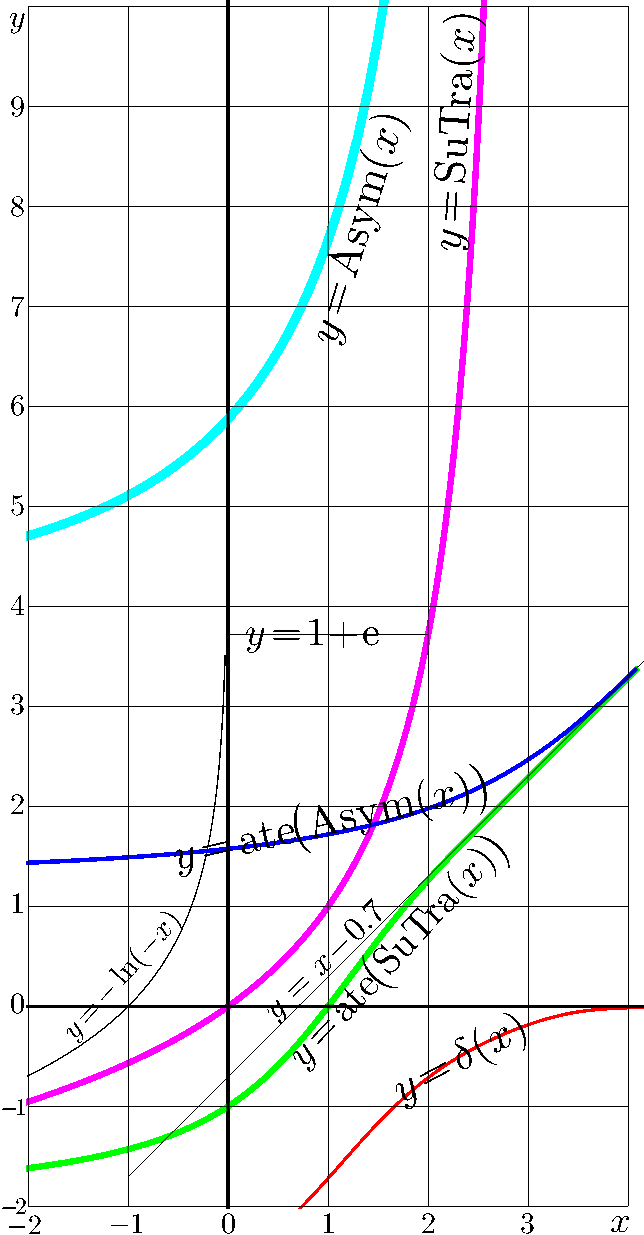 | 644 × 1,235 (28 KB) | T (talk | contribs) | misprint, there was wrong sign in formula y=x-0.7 |
| 16:13, 4 February 2026 |  | 644 × 1,235 (28 KB) | T (talk | contribs) | {{oq|SuTraAsyQ2ateT.png|Original file (644 × 1,235 pixels, file size: 28 KB, MIME type: image/png)|600}} Atemptotic Asym (thick light blue curve) of function SuTra (pink curve) through the growing SuperExponential to base \(\sqrt{2}\). Here, term Atemptotic means the Restrict asymptotic with natural ArcTetration \(\mathrm{ate}\) as the Criterion function. \[ \mathrm{SuTra}(x)\ \underset{\overset{x\to +\infty}{x>0}}{{\overset{\mathrm{ate}}{\Larg... |
You cannot overwrite this file.
File usage
The following page uses this file:
